Malaysia-Singapore Trade: The Growing Opportunities and the Bilateral Integrity and the Import-export Analysis
- Aug 17, 2026
Malaysia-Singapore Trade: The Growing Opportunities and the Bilateral Integrity and the Import-export Analysis
Malaysia and Singapore have maintained their developmental trade with integrity in their trading relationships in Southeast Asia.
The geographical proximity shared, ASEAN membership and extensive logistics as reported by the Malaysia Trade Data has been establishing the manufacturing ecosystems with strong investment relationships. The expansion of the relationship of both regions beyond conventional merchandise trade has supported the extensive trade of electronics, machinery, petroleum products, chemicals, food, logistics, and financial services. The bilateral relationship is important because it has made both nations visible on a global scale.
Singapore was one of the top export destinations of Malaysia, according to Singapore Customs Shipment Data as reported by official statistics. The merchandise trade of Singapore with Malaysia in 2025 is 152 billion US dollars, which has made Malaysia the third-largest trading partner of the country after Taiwan and China. The strong national trade performance of both regions has maintained the integrity between Johor and Singapore while creating new opportunities for manufacturers.
Why is Malaysia-Singapore Trade Important?
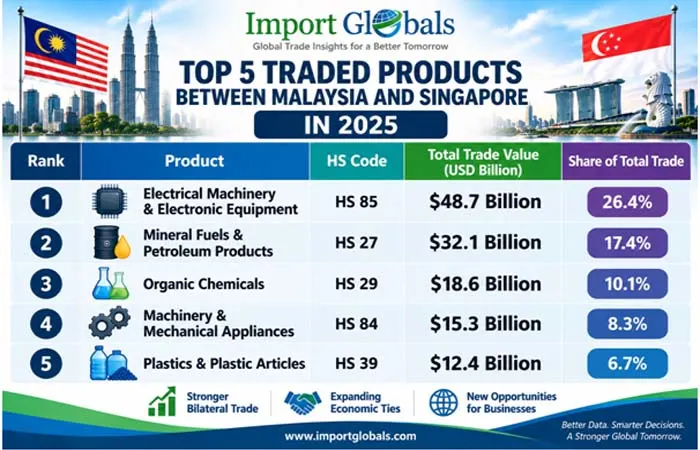
Malaysia-Singapore trade, as reported by the Singapore Customs Trade Data, is a unique factor that promotes the economic relationship because of the geographical proximity and highly complementary economies. The country's integrity has been providing agricultural products, industrial inputs, and energy products. The relationship is particularly significant because it helps the authorities operate in the electronics semiconductor, machinery, chemicals, and logistical industries.
The strategic location has been providing Malaysian businesses with reliable access to the internationally connected commercial and logistics centre. Singaporean businesses have been using Malaysia as an important production, investment, and regional expansion base. The relationship is strengthened by the ASEAN economic integrity and the regional trade agreements. The extensive free trade agreement network has been supporting the Regional Comprehensive Economic Partnership.
Malaysia's Trade Performance in 2025
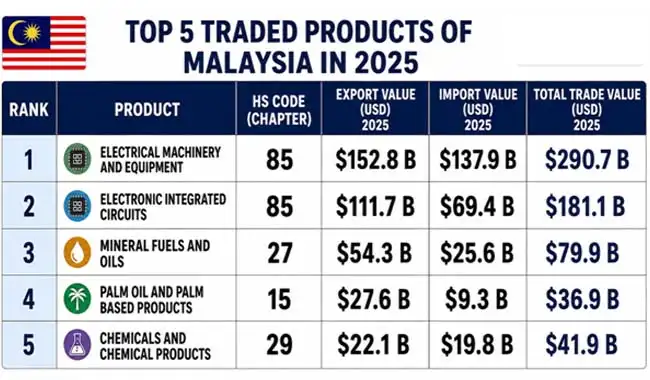
The Malaysia Export Data reported that the country has maintained its position as one of the top facilitating traders with significant investment in its overall report. Trade and industry have increased by 6.3% from 2024. The exports of the country increased by 6.5%, while imports increased by 6.2%. Manufactured products are the major driver of the export growth rate and global trade compliance.
The total trade value of Malaysia has reached a valuation of 3.25 trillion US dollars in 2025. Electrical and electronic products, machinery and equipment, and optical and scientific equipment have supported the export values. Agriculture has mainly contributed to palm oil and palm oil-based products. The overall performance is important because it helps the traders gain deep insight into Malaysia's manufacturing and supply chain ecosystem.
Malaysia-singapore Bilateral Trade in 2025
Singapore has positioned itself as one of the important international trading partners of Malaysia. The official merchandise trade statistics reported the total trade with Malaysia at 148 billion US dollars. The total merchandise trade of Singapore is 1.42 trillion at present.
The Malaysia-Singapore relationship is getting conventional due to the involvement of buyers and sellers in the bilateral trade. It is a two-way supply chain network which encompasses a wide range of sectors like components, intermediate goods, energy, machinery and finished products. The strength of the relationship was visible mainly because of the monthly trade developments.
What Are the Major Products Traded Between Malaysia and Singapore?
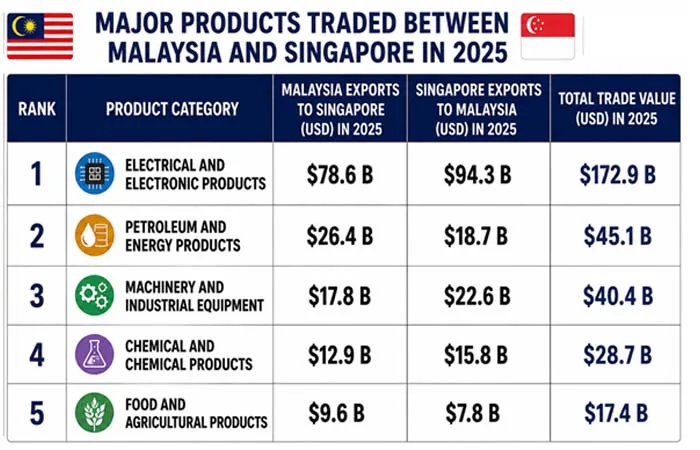
- Electrical and Electronic Products - Malaysia Import Data reported electrical and electronic products as one of the major traded products between both the regions. The E&E sector is mainly integrated with the regional semiconductor and electronic supply chains. The components have been moving between the manufacturing facilities. Electronics and their derivatives are mostly traded to create opportunities for bilateral trade in semiconductors, integrated circuits, electronic components, and testing equipment.
- Petroleum and Energy Products - Petroleum products are mainly reported for Malaysia-Singapore trade. The refining, petrochemical, and energy production have been supporting the trading centres. The proximity allows energy-related products for efficient movement through regional supply chains. Petroleum products, petrochemicals, refined fuels and related industrial inputs have supported the important components of bilateral trade.
- Machinery and Industrial Equipment - Machinery, equipment and industrial components have maintained the developmental expertise of the country in advanced industrial technologies. The cross-border movement of machinery and equipment supports the factories, semiconductor facilities, data centres, and logistical operations.
- Chemical and Chemical Products - Singapore Import Statistics reported chemicals and chemical products as the top variant of traded essentials within both regions. The substantial downstream manufacturing and industrial demand has maintained the existence of trade opportunities across industrial chemicals, specialty chemicals, and petrochemical products. The overall demand rate by the consumer-based population has supported effective trade.
- Food and Agricultural Products - The Malaysian authorities are responsible for the effective supply of food and agricultural products to Singapore. The limited land availability and agricultural production have maintained a heavy dependence on international supply chains. The geographical proximity has provided an important sourcing advantage with effective trade of fresh food, processed food, agricultural products, and beverages.
Why is Singapore an Important Market for Malaysian Exporters?
Singapore is considered an important market for Malaysian exporters because of the short geographical distance. The proximity between both regions has reduced the transportation time and logistics costs. The highly developed ports, airports, warehousing facilities, and financial services have maintained trade integrity.
The positioning of the nation as a regional commercial and re-export hub has maintained the opportunistic trade while creating logistical benefits for the marketing authorities. The sophisticated business environment is supported by the strong demand for high-value products, technology, professional services and industrial goods. The combination of proximity and market sophistication has supported Malaysia as an attractive destination for Malaysian manufacturers, says Malaysia Trade Statistics.
Why is Malaysia Important for Singaporean Businesses?
Malaysia Import Export Data reported Singapore as its top trading partner because of the labour resources, industrial parks, natural resources, and the large domestic consumer market. Johor is mainly important because of the proximity to the Singapore authorities. The Johor-Singapore Special Economic Zone is mainly responsible for the proper exchange of trade and is basically designed to strengthen the economic relationship with the proper improvement of cross-border goods connectivity.
The facilitation of the movement of people and strengthening of regional businesses has streamlined the customs procedure. The agreement has created different opportunities for digital economy activities, food processing, healthcare, education, business services, and other sectors. The Johor-Singapore Special Economic Zone, the new trade opportunity acknowledgement, the JSSEZ, is one of the important developments launched by the government authorities of both regions to shape the Malaysia-Singapore economic relationship. Singapore trade data reported that the objective is one of the top facilitating factors introduced by the government authorities to maintain integrity across Johor and Singapore.
The treatment of the border as a separation between two markets has properly developed the region as a connected investment and production ecosystem. The improved connectivity and the reduced logistic friction have enabled the manufacturing facilities to maintain their regional headquarters, says Malaysia Trade Data. The importers and exporters can simply get benefit with the cross-border manufacturing, electronic production, semiconductor related activities, digital services and food processing along with healthcare and business services. The JSSEZ holds the potential to increase the importance of the Malaysia-Singapore trade on a global scale while maintaining the fulfilment of trade gaps within different regions.
How Does Malaysia-Singapore Trade Data Support Business Growth?
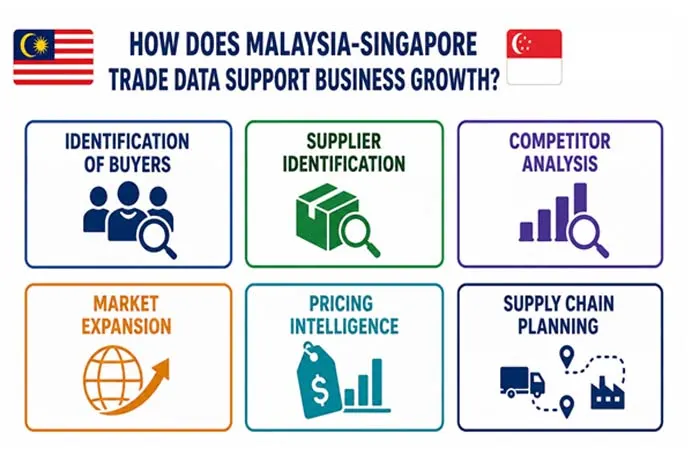
Import Globals Malaysia-Singapore Trade Shipments Data gives a clear visualization to progressive traders regarding the latest traded variants between both economies, while helping the authorities with market expansion, sourcing, distribution, and international sales. Below are the factors supported by the Malaysia Export Trade Data and Singapore Trade Customs Data for helping the authorities with their business intelligence.
- Identification of Buyers - The latest acknowledgement of the buyers of a specific category in both the regions gives a clear visualization to the authorities regarding the product name, product description, and shipment quantities. It helps businesses identify potential customers with Singapore Customs Shipments Data.
- Supplier Identification - The acknowledgement of the Singaporean importers helps the authorities use the trade intelligence to identify Malaysian suppliers actively exporting specific products. It helps the businesses stay updated with sourcing of electronics, machinery, chemicals, and food products.
- Competitor Analysis - Businesses can monitor the competitors exporting to the suppliers to understand their destination markets. The competitor intelligence helps businesses identify markets with acknowledgement of the success and discover the untouched regions of trade.
- Market Expansion - Malaysia Customs Trade Data of Import Globals helps companies understand the product categories that are currently facing strong bilateral trade activities. The businesses can use the historical shipment data to compare the demand rate along with identification of the growth markets and determination of the nation that should enter the new product segments.
- Pricing Intelligence - The trade values and quantities help the authorities with transaction values and market pricing. The companies can combine this information with freight, cost, customs duties, and currency movements.
- Supply Chain Planning - The identification of shipment routes, logistic patterns, and trading partners helps the companies with improvement of supply chain planning. It provides valuable information for businesses operating time-sensitive manufacturing or distribution networks.
Latest Trends in Malaysia-Singapore Trade
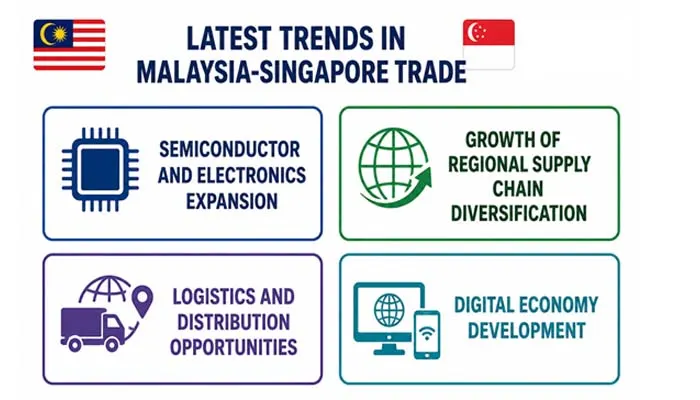
- Semiconductor and Electronics Expansion - The global semiconductor industry is continuously expanding over time. The proper strengthening of Malaysian authorities as a role player in semiconductor assembly is due to the related manufacturing, while Singapore remains an important high-value electronics hub. It has created strong potential for cross-border trade.
- Growth of Regional Supply Chain Diversification - The global companies hold their significance in diversifying the manufacturing and sourcing networks across Asia. The Singaporean authorities have been benefiting from the trend because of the established infrastructure and increased foreign investment. The JSSEZ is likely to encourage different investments in strengthening the economic connection with Singapore.
- Logistics and Distribution Opportunities - The Singaporean authorities have been positioning the country as the top authority supporting the re-export hub. The combination with Malaysia's manufacturing capabilities has created new opportunities for regional distribution networks.
- Digital Economy Development - Digital services have been supporting the effective trade of financial technology essentials and technology-enabled businesses; that have become increasingly important for the broader Malaysia-Singapore economic relationship.
Future Outlook of the Malaysia-Singapore Trade
The future outlook of the Malaysia-Singapore trade is positive, mainly because of the geographical proximity, complementary economic structures, and the establishment of the manufacturing ecosystem. The economies are expected to maintain their important positions in both regions. The development of the Johor-Singapore special economic zone will become one of the major contributors to future bilateral trade. The improvement of cross-border connectivity and the investment in facilitation, logistics development, and manufacturing integration will create additional opportunities.
The semiconductor and electronics industries will remain important areas of trade growth. The capabilities in semiconductor assembly and testing, packaging, and manufacturing will maintain compliance with the advanced semiconductor trade. The increasing demand for artificial intelligence, data centres, and advanced computing will strengthen cross-border trade. The logistics and distribution sector will benefit from the complementary strengths of both economies. The digital economy, financial technology, and healthcare, food processing, as reported by the Malaysia Import Export Data, will serve as an important tool for creating opportunities for beginner traders.
Conclusion
The Malaysia-Singapore trade has been continuously developing as one of the strongest bilateral economic relationships. The economic structures, advanced logistics, manufacturing capabilities, and strong investment relationship have been creating a highly interconnected trade ecosystem. Electrical and electronic products, along with industrial components and logistics services, have maintained important areas of bilateral trade.
The growing integration of manufacturing and supply chains will create opportunities for exporters, importers, and suppliers. The development of the Johor-Singapore special economic zone will provide the authorities with an additional boost to cross-border investment and trade. The initiatives will strengthen the manufacturing, logistics, digital services, and semiconductor activities. The continuous expansion of semiconductor manufacturing, as reported by Malaysian Trade Data, will strengthen the bilateral integrity of both regions.
CTA
Looking for an expansion in your business in the Malaysia-Singapore trade, you have landed at the right platform here. Import Globals holds a specialization in providing detailed acknowledgement of shipment activity, product insights, and buyer information. The platform helps exporters with importers, manufacturers, suppliers, and distributors, trade strategies, and acknowledgement. Subscribe to www.importglobals.com or drop an email at info@importglobals.com to get the latest updates on the Malaysia-Singapore import-export trade data to strengthen your international business strategy.
FAQs
Que. Why is Malaysia-Singapore trade data important?
Ans. Malaysia-Singapore trade data is important because it helps promote highly integrated manufacturing, electronics, logistics, energy investment, and supply chain networks.
Que. Name the top products traded between Malaysia and Singapore.
Ans. Top products traded between Malaysia and Singapore include electronic products, semiconductors, machinery and equipment, and petroleum products.
Que. Why is Singapore an important market for Malaysian exporters?
Ans. Singapore is a top export partner of Malaysia because of the geographical proximity, advanced logistic infrastructure, and strong purchasing power.
Que. Why is Malaysia important for Singaporean businesses?
Ans. Malaysia is important for Singaporean businesses because it helps with manufacturing capabilities, industrial parks, and natural resources.
Que. What is the Johor-Singapore special economic zone?
Ans. The Johor-Singapore special economic zone is an economic agreement designed to strengthen the connectivity, investment, manufacturing, and business cooperation between Johor and Singapore.
Que. How does Malaysia-Singapore trade data support business growth?
Ans. Malaysia-Singapore trade data supports business growth via proper identification of buyers, supplier analysis, market demand, and development of effective market expansion strategies.
Que. What information is available in Malaysia-Singapore trade data?
Ans. Malaysia-Singapore trade data covers Importer names, Exporter names, Shipment date, HS Code, Product Details, quantity, values, pricing information, origin country, importing country & port details.
Que. Name the top beneficiary industries of Malaysia-Singapore trade.
Ans. Electronics manufacturers, semiconductors, machinery, chemicals, and petroleum products are the top beneficiaries of Malaysia-Singapore trade.
Que. How can businesses use the Malaysia-Singapore shipment data for market expansion?
Ans. For analysis of historical shipment activity, destination markets, and product categories, businesses can use the Malaysia-Singapore shipment data for market expansion.
Que. How frequently is the Malaysia trade data and Singapore trade data updated?
Ans. Malaysia trade data and Singapore trade data from Import Globals are updated on a monthly basis.
Que. Where to get a detailed acknowledgement of the Malaysia-Singapore trade data?
Ans. Visit www.importglobals.com or drop an email at info@importglobals.com for a detailed acknowledgement of the Malaysia-Singapore trade data.
You Can Also Visit :-